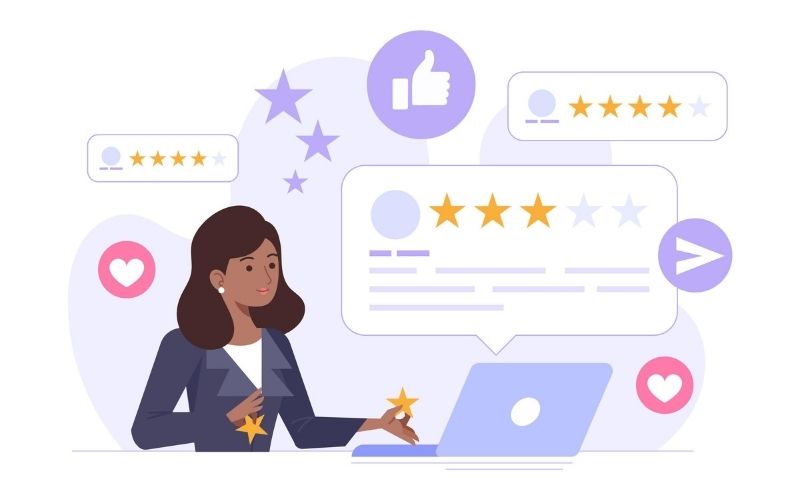
Social proof is the basic human tendency to trust in the actions of the many. From Consumer Reports to Amazon stars to trendsetting Instagram accounts, people need more than facts about a product or promises from a brand to try something new.
According to psychologist Robert Cialdini, the definition of social proof is:
“...people are especially likely to perform certain actions if they can relate to the people who performed the same actions before them.”
The most powerful persuasive tool you have in your customer conversion toolbox is the human voice or social proof.
Social Proof Examples
Imagine you are shopping online for a new hand lotion. You see an ad for Crabtree and Evelyn brand lotion, and you notice three of your friends have liked this brand on Facebook.
First is your aunt Karen, who has excellent taste. She always has premium brands in her fully stocked guest bathroom. Next is your sister, Liz, who is a socially conscious vegan. Liz would never use a product unless it were non-GMO and cruelty-free. Lastly, your co-worker, Michael. Michael doesn’t pay much attention to brands. If he liked it, it must be widely available.
Just from these three likes, you know Crabtree and Evelyn are...
Sophisticated
Eco-conscious
Available at major retailers
Now without ever reading any product information or sales pitches, you know a lot about a potential purchase. Better yet, you don’t have to wonder if the hype is real because it’s coming from people you trust who don’t stand to gain anything from their endorsement.
Informing customers via trusted social media voices is the very definition of social proof.
Social Proof in Marketing
Social proof in marketing can come from something as simple as likes and comments from customers or be as big as a celebrity endorsement. No matter the source, social proof is an essential part of any digital marketing campaign.
The most common social proof in marketing comes from customer interaction. Comments, social media shares, and customer testimonials will naturally occur. By offering incentives, sharing affiliate links with other blogs, or partnering with influencers, you can give those authentic customer impressions the spotlight.
When and where you choose to display those organic customer responses makes all the difference. Blog posts or site pages that are informative rather than persuasive are natural settings for testimonials or endorsements.
HOW'S YOUR SOCIAL PROOF?
Does your brand need help with social proof? I'm here to help. Book a call with me today!
Social proof is NOT an ad copy. The impact of social proof in marketing comes from the fact that the brand does not directly control it. Social proof can’t be faked.
Knowing the importance of social proof in marketing, you might be tempted to do anything you can to ramp up testimonials and endorsements. Remember that the power of social proof is in its genuine, organic nature.
If your potential customers feel they are being swindled or misled by false reviews, all the social proof in the world cannot outweigh the sense of suspicion that follows from just one fake endorsement.
We all live and consume media in a commercial culture. Your customers know a sales pitch when they see one. There is a time and place for sales language in any digital marketing campaign, but it should be kept separate from social proof.
When you present a white paper or highlight social proof in marketing, that is NOT the place for traditional ad copy.
The Social Proof is in the Pudding
Social proof is an essential part of any marketing campaign. As they say in show business:
“ten thousand fans can’t be wrong.”
It’s human nature to assume that the crowd knows more than we do. Social proof in marketing relies on these key features:
Authenticity
Organic generation
Number of responses
Qualitative, informational responses
To learn more about social proof in marketing, the definition of social proof, and how it relates to digital marketing, check out the science behind the concepts in Influence: The Psychology of Persuasion.
If you have other questions about social proof that you’d like answered, get in touch with Geneva.
Have unique experience with social proof? We'd love to hear it! Share your social proof experiences below.
HOW'S YOUR SOCIAL PROOF?
Does your brand need help with social proof? I'm here to help. Book a call with me today!
I decided to make this particular blog post with the sole purpose of sharing my best advice and tips on blogging for small businesses base on my personal experiences over the years. I’ve had quite a few blogs over the years. Not to mention the fact that I occasionally freelance write for other publications as it is genuinely something I enjoy.
The point is, I learned a great deal while blogging for myself and blogging for small businesses. I realized that I was missing some key fundamentals that could have really given my blogs the boost I needed at the time. I learned what works, what doesn’t, and why.
If you're exploring blogging as a career, blogging to earn money, or just curious as to what blogging is all about, you're in the right place. In this article, you'll learn what blogging means for small businesses and how to do it successfully.
h
Table of Contents
$
Learn Everything About Blogging For Small Businesses
$
Have Realistic Expectations
$
Think Long Term
$
Create an Editorial Calendar
$
Incorporate Marketing
$
Collaborate With Others
$
Final Thoughts
Learn EverythingAbout Blogging For Small Businesses
Any business owner will tell you that it's important to delegate tasks to employees or freelancers in order to be more productive and profitable in your business. I totally agree with that sentiment. In fact, it's one piece of advice I always give to business owners. In my opinion, blogging is a task that one should delegate if it's not your passion and you feel that your time could be better spent elsewhere in your business.
However, you should know how to do the thing you want to outsource or delegate. That goes for any and all tasks and operations in your business. That is a painful and expensive lesson I had to learn the hard way. (Story for another time.)
Why is that important? I often compare outsourcing tasks that you don't know how to do yourself, to going to a car repair shop. If you don’t know much about cars, it’s easy to get ripped off.
I'm sure by now you've noticed that I keep emphasizing blogging for small businesses rather than simply blogging. As a business owner whose primary goal is to sell the products or services you offer, that focus should carry over to your blog as well, but not in an overbearing sales pitchy type of way. You want to convert website visitors, not repel them.
Skills you'll need to hone are blogging for SEO while keeping search intent in mind and persuasive copywriting, just to name a couple.
Have Realistic Expectations
Another key fundamental, and possibly the most important, is patience. There are so many great blogs out there that cover the topic of making money through blogging. I fear that many people see the accomplishments, or what seems like the easy and quick success, of popular blogs and think they will create a blog and be an overnight sensation.
The truth is, it can happen. I've personally seen it happen. However, I've never seen a novice pull it off. It's always someone with many years of blogging experience applying what they've learned.
But hey! Anything is possible. Just don't get your hopes up.
That’s why patience and endurance are key. In the beginning, it's going to be slow. Meaning you won’t make a ton of money right away. Not to mention, if you are an absolute novice when it comes to blogging, not only will it be slow but you will also experience an extreme learning curve without the help of a mentor or SEO marketing consultant.
Why an SEO expert? Because you want your ideal customers or clients to actually find your website as opposed to writing content that won't appear on search engines.
READY TO ATTRACT AND CONVERT MORE LEADS TO YOUR WEBSITE?
If you're serious about having a successful blog for your business, I'm here to help. Book a call with me today!
There is so much that goes into the actual development of a blog, like aesthetics, branding, SEO strategy, being compliant (FTC, GDPR, and CCPA), and the overall content planning process before launching your blog. Making the assumption that you already know what you’d like to call your blog and what your niche will be, you have to think about the execution of your blog.
Additionally, you'll want to produce good content that you can eventually monetize. No matter if your blogging for your small business or if you want an affiliate blog, you'll want to eventually promote either your own products or services or someone else's. Whatever the case, blogging for income is the goal.
Assuming that you are like most people who would work in your business and blog at the same time until you reach the point of being able to outsource it, you need to make sure you have a good work/blog balance. It is very difficult to blog while working full time in your business. Difficult, but not impossible. Especially if you set aside specific times to develop your content.
First, you would want to organize an editorial calendar so that you know well in advance what blog posts you will develop. Based on your schedule, the editorial calendar will also help you decide how many blog posts you will develop and how often you will distribute them.
Once you have your editorial calendar all worked out and have set a realistic schedule for yourself to develop your content, you will find that a huge weight has been lifted off your shoulders. Many people say that coming up with blog topics and having writer’s block is one of their biggest challenges.
Incorporate Marketing
Now at this point, you have your content all mapped out for the next six months to a year. Assuming that you already have a blog template in mind or someone you would hire to develop a blog theme especially for you, you need to think about marketing. How would you market your content? You will want to carefully consider which social media platforms you will set up for your blog.
Social media in itself is a whole different ballgame altogether. Considering that people “do” social media for a living, I’d say it’s a big deal. You can of course always hire someone to manage your social media pages for you, however, I wouldn’t recommend that in the beginning.
For one thing, your blog probably hasn’t started making money yet and for another, it’s kind of important to learn how to market yourself on social media. This goes back to my point about learning every aspect of your business. I cannot emphasize enough how important this is.
The good news is, it's really easy to take an online course or hire a digital marketing consultant to teach you about the best social media practices for business. One of the absolute best platforms to take online course is LinkedIn Learning but second to it is Teachable, a company of which I am an affiliate.
Collaborate With Others
Once you have the social media platforms figured out, you would want to consider other marketing efforts like guest blogging. This is a great way to build your SEO because of back linking but it also helps you get in front of more people. It also helps their blog because you give them a bit of a break from developing their own content by offering your well-thought-out content to their readers.
Besides guest blogging, you may want to simply be featured on other blogs or websites for publicity. If a highly recognized platform such as the Huffington Post, interviews you or mentions your blog (in a positive light of course), this will certainly boost your credibility as an expert in your niche.
There are many other ways to promote your content besides paying for advertisements. Personally, I love cross-promoting other bloggers. You can post about another blogger’s content on your social media platforms and they will do the same for you in return. It’s a great way to get started especially if you don’t have the money to spend right away on promoting.
Final Thoughts
Just remember, when starting a new blog, you want to be patient because it will take some time to get your blog to where you would like it to eventually be. If you are a novice, learn as much as you can about blogging and prepare well before launching your blog, that way you can avoid many of the pitfalls most beginners make.
Figure out what social media platforms would be best for your blog and put diligent effort toward marketing. Above all, make sure you have fun and enjoy the journey.
Do you have some key elements you’d like to share on how a blogging can be successful? Tell us in the comments below!
READY TO ATTRACT AND CONVERT MORE LEADS TO YOUR WEBSITE?
If you're serious about having a successful blog for your business, I'm here to help. Book a call with me today!
Note: This article contains affiliate links, meaning we receive a commission (at no extra cost to you) if you use that link to make a purchase. Read our affiliate disclosure here.
Technical SEO (Under the Hood of Search Engine Optimization)
$
Core Web Vitals
$
Safe Browsing
$
Mobile Friendliness
$
Is SEO Marketing?
Search Engine Optimization in 2022
Any marketer knows your digital real estate is only as valuable as it is visible. In an internet landscape with thousands of options available from every SERP, how do you connect with the people who want what you have to offer?
Search Engine Optimization or SEO, is the first step in digital marketing for a business of any size. If you want your ideal customer or client to find your website via Google and other search engines, then SEO isn't something you can forgo.
What does it mean to be search engine optimized? Let’s unpack.
On-Page SEO (with Keywords)
SEO is divided into three main categories: On-page optimizations, off-page SEO, and technical SEO. In this article, we'll focus on on-page and technical SEO since off-page deserves much more attention.
On-page SEO refers to the content on your website. That includes your content structure, content hierarchy, user experience (UX), image alt-text, internal links, and external links.
Search engines like Google and Bing scan all the text your site contains in order to determine what you are about and who is trying to find you. This information is used to generate a Search Engine Results Page (SERP) when a user enters a query.
Not all words are created equal! If you are an e-commerce site that specializes in pet supplies, some words on your page are more important than others! Google algorithm does its best to filter out “contentless” words; the, and, at. Instead, it focuses on the descriptive words; dog, cat, toy, food.
Those contentful words are your keywords. By examining what keywords your content contains and how often they are used, Google determines if your site is a good fit to show a user. This is called keyword density or keyword frequency.
Of course, higher isn’t always better. Would you want to shop with an E-commerce store that contained the word “dog” 120 times and nothing else?
READY TO ATTRACT AND CONVERT MORE LEADS TO YOUR WEBSITE?
If you're serious about your online business, you need SEO. I'm here to help. Book a call with me today!
Technical SEO (Under the Hood of Search Engine Optimization)
SEO is more than just your content. Google Analytics ranks your site based on key metrics called core web vitals. These core web vitals are used to measure how functional your website is.
A site with great content that has broken links, few updates and loads poorly is not user friendly. To make sure Google is displaying your content front and center, check your site against Google’s gold standards for user experience.
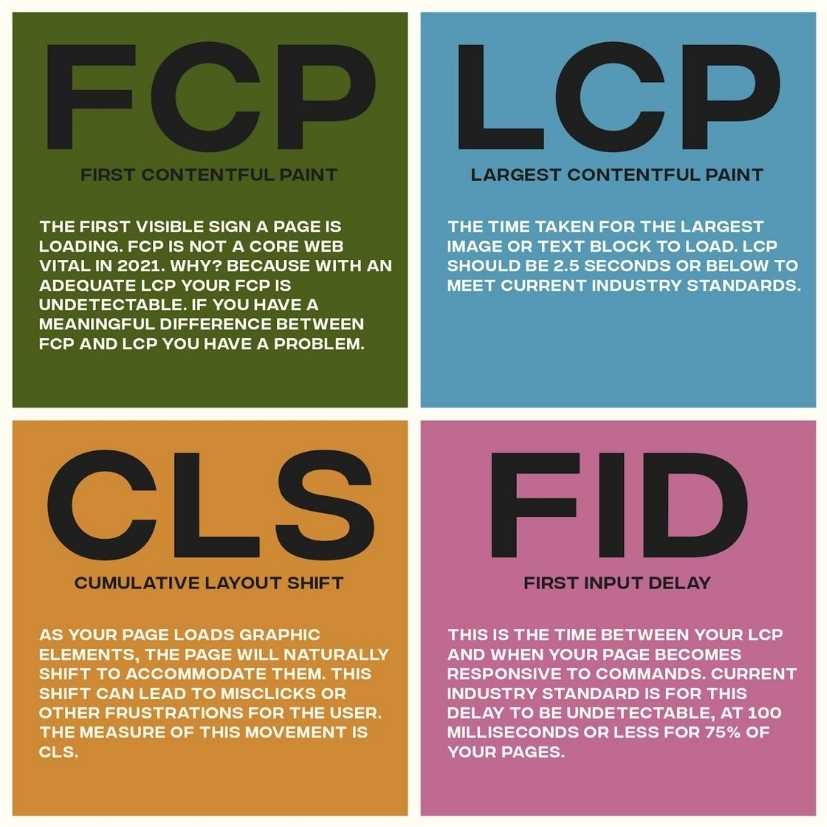
It isn’t surprising that speed is the most important metric of technical SEO. But what does speed mean for your site? Google measures your speed according to 4 measurements.
Core Web Vitals
Domain authority is based on more than just speed. As of the May 2021 update to Google Analytics, there are 2 other key factors that go into determining SERP visibility.
Safe Browsing
As you may have noticed, most sites you visit use HTPPS as their protocol. This is a secure protocol and the current minimum requirement for a page to be considered safe. It goes without saying that your pages should be free of malware, intrusive pop-ups or unauthorized data catchers. The newest addition to your safe site checklist is to use HTTPS.
Mobile Friendliness
Most web users browse as much on their phones, if not more than on a desktop. Why then, are so many sites not mobile optimized? Google is putting the mobile user experience first this year, and that means you should be too. Not sure if your site is mobile optimized? Get your answer from the horse’s mouth with Google Mobile Optimization Checker.
This free tool will let you know if your site is up to grade, and give you actionable advice if it isn’t.
Is SEO Marketing?
Now that you better understand SEO and domain authority, you might be wondering, “Is this marketing?” The simple answer is, yes.
The more in-depth answer is, SEO is a set of best practices for your website. It is by far, the most important and most effective form of marketing that you could ever invest in. All digital marketing campaigns should be launched with SEO in mind. You can’t sell to your market if you aren’t visible to your market. Everything from your text, domain choice, graphics and layouts are all factored in to your placement on a Google and other SERPs.
If you are unsure about your marketing and what it means for your digital presence, chances are you need an SEO marketing consultant who can help you implement SEO for your business yourself. Or a better option would be to hire a marketing agency that specializes in SEO to handle everything for you. When looking for that consultant, make sure they offer you a service that keeps SEO best practices front and center.
READY TO ATTRACT AND CONVERT MORE LEADS TO YOUR WEBSITE?
If you're serious about your online business, you need SEO. I'm here to help. Book a call with me today!
If you're like most businesses, you probably sell more than one product or offer more than one service. If there are significant differences in the products or services you offer, then there will likely be significant differences in the interest of your customers. In order to market effectively, you need to target and promote your products or services to your customers based on their interest. In this article, we're going to outline customer segmentation best practices.
What is customer segmentation?
Simply put, customer segmentation is the practice of dividing broad markets of people into smaller subsets or target groups. This dividing is done using demographics, spending habits, and general interests. This makes it easier for marketers to effectively target groups of people based on their interest in certain products or services.
Step 1: Focus on effectiveness over efficiency.
The main objective of customer segmentation is to both recognize the differences between your groups of customers and craft tailored marketing messages to each one. That being said, if you're targeting every group with the same message, then what's the point? You'd be better off not putting any effort into segmenting your audience if you're going to do that.
Of course, it can be much more efficient to send all of your customers the same marketing messages, but it will be much less effective.
Effective campaigns come from an understanding of segment values, motivations, and engagement. When focusing on effectiveness over efficiency, conversion rates are increased.
Step 2: Keep the correct metrics in mind.
It's easy to get caught up in tracking all the metrics, but that's not the best practice. In fact, tracking too many metrics can be unnecessarily overwhelming. So figure out which metrics are absolutely necessary to track and stick with those.
This comes down to efficiency. It’s easier to keep track of a handful of useful metrics than it is to monitor every metric available. This will help you maintain a high level of attention to what really matters.
The best way to determine which metrics or key performance indicators (KPIs) to pay attention to, is first determining what your goals are. For example, if you want to make more sales this year than you did last year, then you'd want to track your year-over-year growth.
Step 3: Be specific.
This might be obvious but, make sure your segments are easily distinguishable. While overlapping is unavoidable, you don't want too much overlapping between segments nor do you want segments that are too broad.
A good rule of thumb is to have each segment defined by no more than three terms categories or descriptors.
Step 4: Get familiar with all available customer segmentation models.
There are a number of great segmentation models, so try to become familiar with each one. For example, a company could choose to follow a behavioral model, a demographic model, or a needs-based model depending on their objective.
Each model has its pros and cons, as well as its ideal uses, which is what makes it so important to have a general understanding of each one. The goal is to have maximum effectiveness when it comes to deciding on a segmentation model.
Step 5: Avoid segmentation bias.
The biggest problem that businesses face during the segmentation process is bias. Bias tends to happen when questions are phrased or posed in a way that solicits a certain response from customers. For example, if you submit a survey to your customers or run a poll, your questions can be leading.
This bias effectively alters the data that is received and recorded. As a result, this leads to inaccuracies that can prove to be detrimental to the segmentation-conversion process.
How can you avoid segmentation bias? If you're planning on using survey or polls to help you better segment your audience, avoid leading questions that don't allow for genuine responses. You may also want to allow the customers to provide written answers just in case they don't see an answer that is applicable to them in the provided choices.
Step 6: Be open to optimization.
Because segmentation is an ongoing process, there’s a good chance that the initial customer segmentation will contain flaws or areas that can be improved. That's why it's a good idea to always be open to optimization.
This can be done by making small changes and monitoring over time. This is called A/B testing or split testing. The goal is to continue to make changes in order to better understand your audience.
Final Thoughts
Customer segmentation is an incredibly important part of the conversion process. Without it, it can be hard to know which customer group to target and which should be avoided for a particular campaign or product.
We hope you find our breakdown of customer segmentation best practices useful and that you can implement what you learned into your marketing strategy. Did we leave anything out when it comes to customer segmentation? Tell us in the comments below!
If you’re a small business owner new to SEO, you probably heard that link building is an important part of your SEO strategy. Effective link building strategies can significantly improve your keyword rankings in search engine result pages (SERPs). In this article, we'll break down how to do link building correctly and mistakes you need to avoid.
There are a few different link building strategies available. Hopefully, you'll find one or two on this list that you can easily incorporate into your DIY SEO routine.
1. Find Broken Links
Website visitors don’t want to be redirected to a page that’s broken or doesn’t exist. Sadly, we're all guilty of having broken links on our websites at some point. This usually occurs when we update or remove obsolete content but forget to update the links that lead to the new content. As a result, website visitors are redirected to non-existing pages.
This strategy involves searching for broken links on other relevant websites. Your goal is to find broken links on other sites and get the site owner or webmaster to replace those links with your relevant links.
This strategy means that you’ll need to find broken links and notify the host. Then, you can offer them your link as a replacement. It’s effective because you are helping them fix their broken link, which hurts their SEO. But this strategy only works in your benefit if your link is relevant! That means, you want your link to lead to a similar piece of content that it would be replacing. Ideally, you'd want your content to be much better because this will give the website owner more incentive to use your link rather than find one on their own.
Once you find broken links, see if any of your current blog content can replace those broken links. You may need to update current content or you may want to develop new content altogether. The choice is yours!
The last step is to find the webmaster's contact information and send your pitch email. Always be professional and polite and tell them why their audience would benefit from your content. What about your content makes it useful or informative? Give the webmaster a good reason to replace the broken link with your link.
Avoid providing irrelevant or unrelated links!
2. Reclaim Lost Links
Your website will inevitably lose links over time. That means, other websites that have linked back to yours will stop linking back to it at some point. This is a natural process and doesn’t reflect the quality of your website in any way. However, there is a way to remedy the loss of these links.
When you lose a link it’s typically because the webmaster removed your link on purpose or by accident, the website is down or deleted, or the URL of their site has changed. Before reaching out to the owner of the site, try to figure out on your own why the link was removed. That way, you'll know how best to approach the situation.
When reaching out to website owners, be sure to be professional and friendly. Inform them that the link you previously had on their webpage was removed and ask them if it can be put back.
3. Comment on Forums
Forums are great places to promote content, which is an opinion that’s been observed by SEO geniuses around the world.
We use forums to promote content by inserting links to our posts and pages. We don’t do this by blatantly posting the link out in the open, though. Instead, we make an informative, well-thought-out comment and insert our link into the relevant part of the comment.
For example, if we’re commenting on something about financial growth, we might write up a comment that suggests a tip to grow financial wealth and then insert our link into a relevant word or phrase such as “improve your wealth”.That word or phrase is referred to as the anchor text. The anchor text is the visible, clickable text in the hyperlink.
Forum comments receives a lot of visibility and often show up in SERPs for specific questions or topics.
How to do it?
Find industry relevant forums and join them. Each forum will have their rules so be sure to read and abide by them. Then share helpful comments that contribute value to the conversation.
Avoid being spammy at all cost!
4. Find Unlinked Mentions
With so many people running websites and blogs, there’s bound to be overlap in terms of mentioning other creators. Often, when someone mentions your product or your website, they don’t link directly back to you. This means that interested parties must conduct a search to find you and, let’s be honest, no one has a ton of time for that in today’s world.
This is probably one of the easiest methods of obtaining a backlink to your website. This is because the webmaster already mentioned your brand, evidently finding your content good enough to share with their audience. So, there's not much convincing you would have to do.
How to do it?
At this time, we were not able to find any free tools that allow you to discover brand mentions but there are plenty of premium tools that offer this service. Simply Google brand mention tool and choose one that's best for you.
When you find a mention of yourself, reach out to the website owner and simply ask if they would be comfortable linking out to you. One convincing argument could be, when a visitor reads their blog and comes across your brand, they can just easily click a hyperlinked anchor text that would direct them to your relevant content.
5. Steal Links
Okay, before you come at us for stealing links from other people, hear us out.
Have you ever come across a truly terrible blog post or piece of website content? The kinds of pages we’re talking about will have very little useful content, poor format, broken links, obsolete information, and a host of other issues.
If you have, and you also happen to have a piece of content similar to said poor content (but much better in terms of quality!), then you’re already in the market for using the link stealing link building strategy.
How to do it?
When you find this inferior content, reach out to the website owner and ask them to consider your content instead. Be respectful, and polite and never insult the content that you're trying to replace. You never know what the webmaster's relationship might be to the original content creator.
Let the website owner know why your content would be helpful for their audience and mentioned aspects of your content that perhaps the original contributor didn't include. If they see the value in your content, they should have no problem removing the existing link and replacing it with yours.
6. Write Testimonials
Writing testimonials is a lesser-known strategy that deserves a spot on this link building strategies list. It’s a great example of nepotistic opportunities that can land you a link on a trusted, high-traffic site.
Testimonials benefit both you and the brand you're writing a testimonial, that is of course, if you truly had a good experience working with them. You never want to be dishonest when writing reviews or testimonials. Never fabricate a positive testimonial simply because you want to receive a link back to your website.
This strategy doesn't work well when you’re dealing with contractors and service providers that have nothing to do with your industry. The goal is to receive backlinks from relevant websites that are either in your industry or an industry similar to yours.
This is because you want search engines to accurately categorize your website and the content on it. If you have backlinks from multiple websites that have nothing to do with your industry, it won't be clear to the search engines what your website is about.
Contractors and service providers in relevant industries, who have provided you with top-tier service, are perfect for this strategy. No doubt, they’d appreciate having a good testimonial to publish on their platform and you'd appreciate having a link from an industry relevant quality website.
How to do it?
Reach out to industry relevant professionals you've worked with and had a good experience with. Offer them a positive testimonial in exchange for a link.
7. Pillow Links
Pillowing is one highly effective way to beat the search engine algorithms and get your content noticed. Essentially, you add natural links, without anchor texts and hyperlinking, to webpages. These links are typically nofollow links, which means these websites won't pass along any website authority to your website.
Why would you want to obtain nofollow links? Well, because it's important to have both types of links. Pillow links diversify your link profile, making it appear normal.
There are several pillow link building strategies that you could use but the most popular include:
Video Links
Video links are most commonly found on video sharing platforms such as YouTube. To make use of video links, you would post a video about a topic and then, in the video description, post a link to your website or blog where viewers could find more information.
Citations Sites
Citation sites include websites like Yelp, Yellow Pages and the like. You would simply set up a profile on each of these sites that include a link to your website.
Directory Links
Directories are basically online phonebooks for businesses. These directories can be fantastic tools for redirecting traffic to your content once you create a link.
You can create links by finding and adding your site to relevant industry related directories that are accepting new submissions. The best ones that are less spammy, typically require a fee.
Professional Organizations
No matter the industry you're in, there’s probably an organization dedicated to it. Simply search for and join, likely for a fee. You should receive a dedicated profile page on these websites.
You can also consider joining multiple chamber of commerce organizations in your regional area. Again, for a fee. Most have websites where they will provide their members with a dedicated business profile as well.
8. Guest Post
Many great agencies have been built by guest posting. Yes, it’s an old tried-and-true strategy that takes a fair amount of time, but it also happens to be one of the most effective link building strategies for creating links and improving traffic. In addition, guest posting allows you to create strong relationships with top-of-the-line influencers.
The downside, this method requires that you regularly reach out to other blogs on a consistent basis. So this isn’t the method for you if you’re hoping for a passive way to build connections.
Guess posts don’t typically look like anything other than a regular blog post and for the most part, there’s no real way to decipher what’s a guest post and what isn’t. But, if you’re writing a guest post for a blog or website, you can easily insert relevant links to your content into your post.
Just make sure that your links fit naturally into your post and makes sense.
How to do it?
Reach out to relevant blogs that are in your industry or closely related industry and ask them if you could submit a guest blog post. Be professional, polite and convincing! Some blogs have guest post submission pages that outline the requirements for submissions. Read those pages and make sure you follow their requirements.
For the blogs without submission pages, find the contact information for the webmaster and submit an email. Let the website owner know why your submission would be beneficial, or useful, or relevant, or informative for their audience.
It may be a good idea to give them at least two different topic ideas. In order to do that, you'd need to become familiar with the content they produce. You won't want to submit content that isn't consistent with what they already produce but you also don't want to submit anything they already have.
You could also simply ask the site owner if there is a piece of content they'd be interested in you producing.
Conclusion
There you have it! Eight easy link building strategies that you can improve your SEO rankings this year. All these methods are useful and, depending on your personal preference, you’re likely to find one or two (or more!) that work for you. Have any questions about this article? Or perhaps you’d like to share some link building methods we haven’t mentioned. Drop us a line in the comment section below. We’d love to hear from you!